


Visual OS | How Brand Identity Evolves from Static Guidelines into an Executable System in the AI Era
人工智能
Xinming Design
VI Standards / Visual Governance
www.xinming.sg
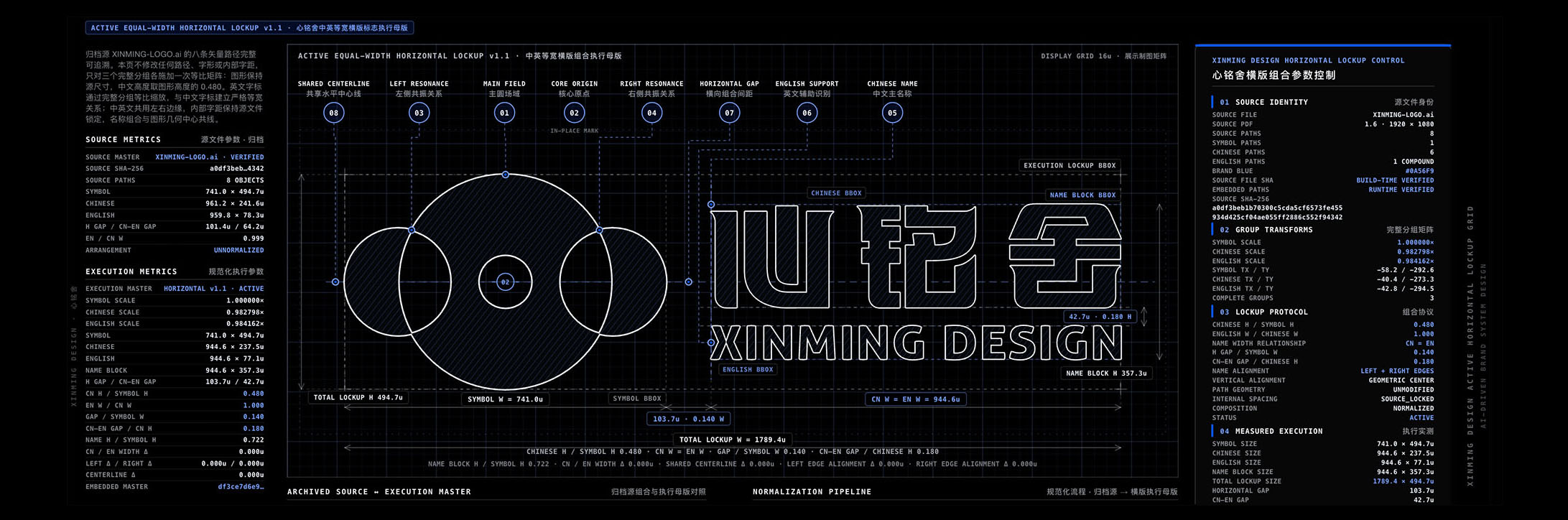
Brand overview
Xinming Design’s Visual OS integrates brand strategy, visual standards, parameterized rules and AI-assisted auditing into a callable, executable and auditable brand visual operating system.
It converts logo architecture, lockup ratios, color systems, typography, layout grids, application boundaries and aesthetic judgments into structured rules that can be understood and applied by designers, internal teams, external partners and AI systems.
Within this model, human creativity remains responsible for defining meaning, direction and value. Parameterized systems stabilize execution. Brand audit agents continuously identify deviations, trace problems back to their governing rules and support correction.
The purpose of Visual OS is therefore larger than maintaining visual consistency.
It enables a brand to remain clear, coherent and controllable even when content production becomes faster, distributed and increasingly automated.
Visual OS represents the next evolution of VI:
from static guidelines to a brand system that can be called, executed, audited and continuously governed.
From Brand OS to Visual OS: How Brand Identity Becomes an Operating System in the AI Era
For decades, the primary role of a visual identity system was straightforward:
keep the brand consistent across different media.
A traditional VI manual defined how the logo should be used, which colors were approved, how typography should be selected and how layouts should be constructed.
Design teams documented these rules, then passed them to marketing departments, advertising agencies, production partners and suppliers.
The system worked because brand production was largely human-driven.
Content was created at a relatively limited speed.
Mistakes could be identified through experience, communication and manual review.
AI has changed that operating environment.
Today, copy, advertising, presentations, websites, product interfaces, social content, images and video can be continuously generated by different models, agents and automated workflows.
The central challenge has therefore shifted.
Brand management is moving from:
How do we keep design consistent?
to:
How do we govern brand output at machine scale?
The faster AI produces, the faster an unconstrained brand can drift.
An incorrect logo proportion can be replicated across dozens of assets.
An undefined visual style can generate conflicting identities across multiple channels.
A piece of messaging that deviates from the brand’s core narrative can be reused and amplified throughout automated workflows.
Efficiency does not automatically create consistency.
Without structured governance, small deviations can become systemic brand drift.
01. Static Brand Guidelines Are Losing Their Governance Power
Traditional VI manuals were designed primarily for human interpretation.
A designer can understand instructions such as:
“Use appropriate whitespace.”
“Keep the visual expression premium.”
“Adjust according to context.”
“Maintain the brand tone.”
These statements rely on human experience, aesthetic judgment and contextual reasoning.
AI systems cannot execute ambiguous judgment with the same stability.
Terms such as:
more technological,
more international,
more premium,
more aligned with the brand
can produce dramatically different outcomes across different models, prompts, teams and workflows.
When a judgment has not been translated into explicit rules, parameters and constraints, consistency becomes difficult to maintain.
This creates a new requirement for visual identity infrastructure.
Brand standards must evolve from documents designed to be read by people into systems that can also be:
understood by people,
called by AI,
executed by software,
and audited by agents.
This is the transition from traditional VI to Visual OS.
02. Brand Parameterization: Turning Aesthetic Judgment into System Rules
A callable visual identity begins by transforming implicit design knowledge into explicit structure.
A logo can no longer exist only as a vector master file.
Its system may also need to define:
Geometry and path structureLockup relationshipsProportional rulesMinimum sizesClear spaceAlignment principlesBackground conditionsApproved variantsProhibited transformationsReproduction tolerances
The same principle applies to color.
A contemporary brand color system requires more than HEX, RGB and CMYK values.
It may also define:
Primary and secondary hierarchyUsage proportionsContrast requirementsBackground relationshipsAccessibility conditionsMedium-specific adaptationsAcceptable deviation thresholds
Typography, grids, imagery, icons, motion and digital applications can also be converted into structured relationships.
This represents a deeper shift in the professional value of VI design.
The designer’s task increasingly includes the ability to:
extract judgment into rules,
translate rules into parameters,
and organize parameters into an operating system.
Xinming Design’s Visual OS is built on this principle.
It brings together logo logic, vector structures, lockups, color systems, typography hierarchies, layout grids, application boundaries and visual governance rules within one structured brand framework.
This allows designers, content teams, external suppliers and AI tools to work from the same source of visual truth.
The brand standard therefore enters the actual production process.
It no longer remains confined to a PDF guideline delivered at the end of a project.
03. Callable: Making Brand Rules Available to People and AI
A rule has limited operational value if it cannot be accessed when production happens.
This is why callability becomes a fundamental capability of Visual OS.
Before a task begins, a designer, team or AI agent should be able to retrieve the relevant brand information:
Brand positioningBrand worldviewCore narrativeVisual principlesApproved logo structuresTypography hierarchyColor rulesImage directionLayout constraintsApplication boundaries
Different tasks require different subsets of the system.
A social media visual may need image style, typography, logo placement and color rules.
A presentation may require grid logic, information hierarchy and corporate typography.
A product interface may require digital color specifications, iconography and responsive spacing.
A campaign may require both narrative and visual governance.
Visual OS organizes these rules so they can be called according to context.
The system becomes a working resource rather than a passive reference.
04. Executable: Bringing Brand Standards into AI Workflows
Once visual standards become structured, they can participate directly in production workflows.
Before generation, an AI workflow can reference brand positioning, narrative rules and visual constraints.
During generation, it can apply approved colors, typography hierarchies, logo combinations, layout systems, image direction and tone of voice.
After generation, a separate auditing layer can evaluate whether the output remains within the approved brand boundaries.
The workflow becomes:
Rule Retrieval → Content Generation → Brand Audit → Feedback → Correction
This changes the role of the VI system.
Instead of appearing only before production as a guideline—or after production as a checklist—it becomes part of the production pipeline itself.
Visual identity becomes executable.
Brand rules move closer to the moment where decisions are actually made.
This is one of the fundamental differences between a conventional VI manual and Visual OS.
05. Auditable: The Scarce Capability in the Age of Infinite Generation
Generative capability is becoming widely available.
Companies will not lack tools capable of producing:
images,
videos,
copy,
web pages,
presentations,
campaign assets,
and social content.
The more difficult capability is determining whether those outputs are correct for the brand.
Visually attractive does not automatically mean brand-compliant.
Fast does not automatically mean ready for publication.
One successful generation does not guarantee long-term consistency.
This is why Xinming Design introduces the concept of the Brand Audit Agent within Visual OS.
The audit layer evaluates outputs against the company’s own:
Visual OS,
Brand OS,
brand knowledge base,
and approved governance rules.
Depending on the asset, the system can examine questions such as:
Has the logo structure been modified?Are proportions and clear space correct?Are brand colors within approved parameters?Is typography being used according to hierarchy?Does the composition violate layout rules?Has the image style drifted away from the brand?Does the verbal expression remain aligned with the brand narrative?Do assets across different channels still feel like the same brand?
The important point is traceability.
A judgment should have a rule behind it.
A deviation should have an identifiable cause.
A correction should be able to become new operational knowledge.
Over time, the system accumulates learning from repeated execution and review.
This turns brand auditing into an ongoing governance mechanism rather than a final approval step.
06. From Human Memory to System Memory
Traditional brand consistency depends heavily on people.
Senior designers remember how the brand should look.
Marketing leaders remember earlier decisions.
Long-term suppliers understand unwritten preferences.
Experienced teams know which exceptions are acceptable.
But organizations change.
People leave.
Teams expand.
Agencies rotate.
Suppliers change.
AI tools are replaced.
When brand knowledge exists primarily in human memory, continuity becomes fragile.
Visual OS moves critical judgment into system memory.
The objective is not to remove human judgment.
It is to preserve the outcomes of good judgment so they do not have to be rediscovered every time a new person or tool enters the workflow.
Human creativity continues to define intent.
The system protects continuity.
This becomes increasingly valuable as organizations produce more brand content across more channels with more participants.
07. The Role of Brand Design Companies Is Being Redefined
AI can already generate increasingly sophisticated visual outputs.
But AI cannot independently determine what an organization should stand for.
It cannot take responsibility for deciding:
what should remain consistent,
what can evolve,
which cultural signals belong to the brand,
which aesthetic choices dilute its identity,
which rules are fundamental,
and which exceptions are strategically justified.
These decisions require:
brand strategy,
commercial understanding,
cultural interpretation,
aesthetic judgment,
and organizational responsibility.
This changes the role of an AI-driven brand design company.
Three capabilities become increasingly important.
1. Judgment
The ability to define the brand’s direction, values and aesthetic position.
2. Systemization
The ability to convert complex human judgments into explicit rules, parameters and structures.
3. Governance
The ability to use systems and agents to maintain those rules across large-scale, distributed production.
The relationship can be summarized simply:
Humans define intent.
AI scales execution.
Agents audit output.
Systems preserve continuity.
This is a fundamentally different operating model from traditional brand design.
08. From Brand OS to Visual OS
Visual OS does not exist independently from brand strategy.
It operates as a visual execution and governance layer within the broader logic of Brand OS.
Brand OS answers questions such as:
Who is the brand?
What does it believe?
What should remain consistent?
How should it make decisions?
How should it communicate?
Visual OS translates those strategic judgments into visual rules that can operate in real production environments.
The relationship can be understood as:
Brand OS defines the judgment.
Visual OS defines how that judgment appears and behaves visually.
Together, they create continuity between strategy and execution.
This relationship becomes increasingly important in AI workflows because a visually compliant output can still be strategically wrong.
Likewise, strategically correct messaging can still become visually fragmented.
Brand OS and Visual OS therefore need to operate together.
One protects meaning.
The other protects expression.
09. Why “Controllability” Is Becoming a New Brand Advantage
The greatest branding risk in the AI era may no longer be insufficient production capacity.
It may be the opposite.
Production capacity can grow faster than governance capacity.
A company may now generate in one day the amount of communication it once produced in a month.
It can also create in one day a level of brand inconsistency that previously took a year to accumulate.
This makes controllability strategically important.
An advanced visual identity system must answer more than:
What should the brand look like?
It must also answer:
How can machines understand the brand rules?
How are those rules called during generation?
How do different AI agents remain within the same boundaries?
How is compliance evaluated?
How are deviations detected?
How are corrections recorded?
How does the system evolve without losing identity?
These are governance questions.
And they are becoming central to brand design.
10. From Static VI to a Brand Visual Operating System
The transition can be summarized across four stages.
Static VI
A visual manual defines how the brand should look.
Parameterized VI
Design judgment is translated into explicit rules and measurable relationships.
Visual OS
Those rules become callable and executable across people, software and AI workflows.
AI Brand Governance
Agents continuously audit outputs, detect drift and support ongoing correction.
This represents a fundamental evolution in brand identity design.
The output is no longer simply a set of visual assets.
It becomes brand infrastructure.
A system that can operate across:
teams,
agencies,
markets,
platforms,
AI models,
automation workflows,
and future production environments.
For Xinming Design, this is the direction in which VI is evolving:
from static standards to callable, executable and auditable brand systems.
And the division of responsibility becomes increasingly clear:
Creativity is defined by people.
Rules are carried by systems.
Standards are protected by agents.
That is the logic behind Visual OS.